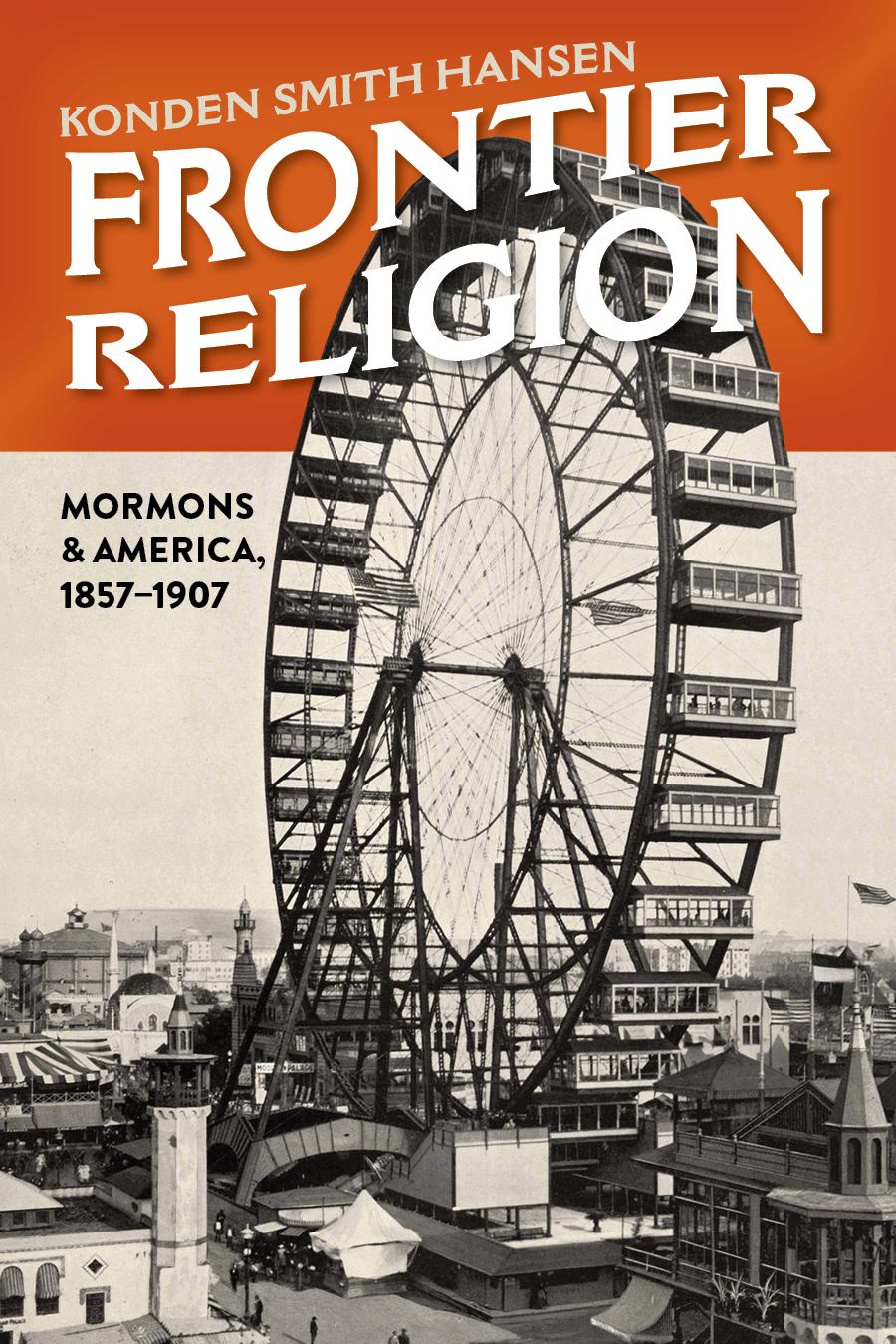
At the 1893 Columbian Exposition in Chicago, Mormons were deliberately excluded from one of the main attractions, the Parliament of Religions. Organizers believed that Mormonism, with its connections to polygamy, did not merit a place alongside other world religions being showcased for the similar ways in which they inspired people to follow God. At the same time, however, Americans who had long shown hatred or distrust toward their Mormon neighbors had begun to see Mormonism in a different light. Underlying this new view of Mormonism was a rapidly developing belief in America’s fading western frontier as a place linked to core American values such as self-reliance, personal freedom, and democratic rule. With a unique history intimately tied to the frontier, Mormonism began to be seen less as something outside America, and more as a faith closely associated with the country’s most important principles.
In Frontier Religion Konden Smith Hansen examines the dramatic influence these perceptions of the frontier had on Mormonism and other religions in America. Endeavoring to better understand the sway of the frontier on religion in the United States, this book follows several Mormon-American conflicts, from the Utah War and the antipolygamy crusades to the Reed Smoot hearings. The story of Mormonism’s move toward American acceptability represents a larger story of the nation’s transition to modernity and the meaning of religious pluralism. This book challenges old assumptions and provokes further study of the ever-changing dialectic between society and faith.
“Best First Book” Award from the Mormon History Association, 2020
Praise and Reviews
“The notion that the frontier marked out and shaped what Americans understood to be first Christian and then modern, and that their manipulation of the concept revealed a contest over those terms, is exciting. Smith Hansen and his book deserve commendation for that.”
—Matthew Bowman, Church History
“Konden Smith Hansen demonstrates not just Mormonism’s interactions with Protestantism, but how both traditions, as well as the relationships between them, were connected to larger trajectories in the history of American religion and the growing secularization of the state. The monograph is a model for future studies that seek to connect Mormon history with larger narratives in American religious history and American history more generally.”
—James Bennett, Santa Clara University
“Though many have claimed that Mormonism is the ‘American religion,’ the history is much more complicated. Konden Smith Hansen persuasively argues that in order to understand how that idea came to be, we need to first understand how the definitions of ‘American,’ ‘religion,’ and even ‘Mormonism’ transformed at the turn of the twentieth century. In this provocative study, Smith examines together a series of case studies that are traditionally kept separate, and in doing so demonstrates how Mormonism evolved from a kingdom to a denomination, and America from a religious empire to a secular nation-state.”
—Benjamin E. Park, Sam Houston State University
“The scope of Konden Smith Hansen’s Frontier Religion is ambitious. Indeed, any of the three major elements of this book (the kingdom of God and the frontier; secular modernity, religion, and the frontier; and the Progressive movement, religion, and the postfrontier) could fill its own volume. However, if ambitious, Smith Hansen dexterously navigates issues ranging from religious liberty and secularization to millenarianism and the popular reception of the Frontier Thesis, all while weaving these themes through an innovative treatment of Mormon history in its national context. Frontier Religion is a strong, original addition not only to the literature of late nineteenth-century Mormon history and its post-1890 transition period, but to broader religious studies-based meditations on the place of religion in frontier and postfrontier American governance. Highly recommended.”
—Journal of Mormon History
“The best histories offer us both a better understanding of the past in its own context, and hold up a mirror to our more complex present. Smith Hansen’s book serves up both in ample portions.”
—Association for Mormon Letters
“Frontier Religion is ambitious and provocative. Like a kaleidoscope, this multilayered history recombines and reconfigures familiar elements of American history to reveal new or insufficiently considered elements. Hansen’s effort to reopen the frontier as an interpretive framework for Mormon history and, through Mormon history, American history is well worth the effort. This paradigm is especially valuable for its utility in placing religion at the center of the formation of the modern, secular American nation.”
—Mormon Studies Review
“Frontier Religion is not just a book about Mormonism. Though a specialist’s knowledge would partly facilitate the reading, there are bigger themes at work, showing American perception of the relationship between religion, the frontier, and the state…… This book could be used in undergraduate or graduate courses in American history (and the frontier), religion and politics, gender, and American religious history, to name a few. It will also appeal to general non-specialist readers, even those unfamiliar with the subject matter, inspiring curiosity and interest. Smith Hansen’s comprehensive bibliography also encourages further reading on the fascinating intersections between religion, the frontier, and the state in the late nineteenth and early twentieth centuries.”
—Nova Religio
 kondensmithhansen.com